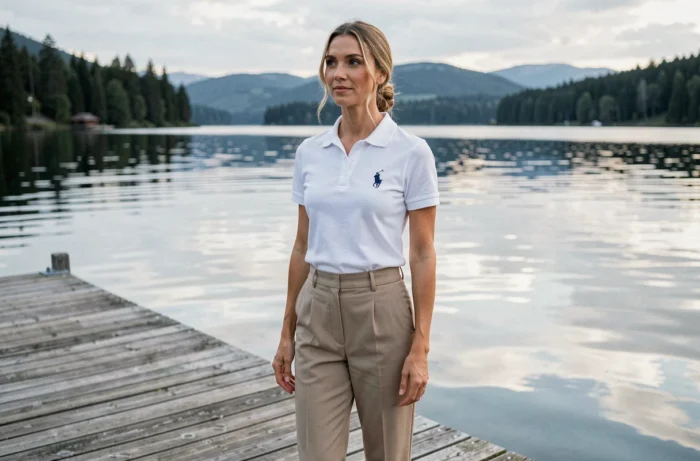
Ralph Lauren launched his brand in 1967 with a collection of ties. Five years later, in 1972, the short-sleeved mesh polo made its debut, accompanied by the famous logo featuring the polo player. The number 3, embroidered prominently on some models, has become one of the brand’s most recognizable visual codes. Its origin is rooted as much in the sport of polo as in an image strategy built over several decades.
The number 3 and the polo captain: a precise sports code
On a polo field, each player wears a number ranging from 1 to 4. The number 3 is traditionally worn by the captain, the most offensive player and often the most talented on the team. This leadership role, this central figure, was not chosen randomly by Ralph Lauren.
The official product description of the Big Pony polo on the brand’s website describes the number as the one typically worn by the captain of a polo team. The number does not refer to a specific player or a historic match. It embodies a position, a leadership function on the field.
By adopting this code, Ralph Lauren transplants a sports hierarchy into the civilian wardrobe. Wearing the 3 associates one with the figure of the captain without ever having touched a mallet. This symbolic transfer between the field and the street constitutes the central mechanism of the appeal of the number 3 polo. To delve deeper into the meaning of the number 3 polo on Magie des Bijoux, the number is analyzed from the perspective of clothing symbolism and its roots in equestrian sport.
Big Pony Polo: how the number 3 became a graphic element
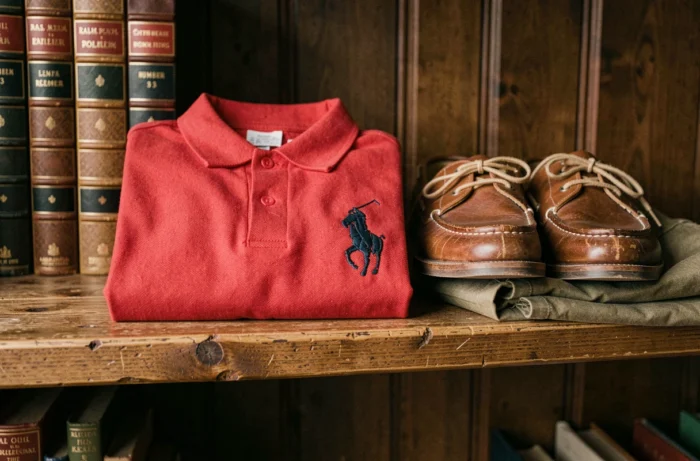
The number 3 is not limited to a discreet embroidery on the chest. On the Big Pony line, it is oversized, applied as a patch on the right sleeve, while the horseman occupies almost the entire front of the polo. This graphic treatment transforms a simple number into a visual signature.
Ralph Lauren applies this code to other pieces beyond the classic polo. Children’s hoodies feature the same number, in the same typography. The 3 transcends the polo and contributes to the visual identity of the entire line.
This choice of emphasis recalls professional sports jerseys, where the player’s number is as visible as the team’s name. The brand blurs the boundary between sportswear and fashion piece. The number 3 polo functions like a jersey one would wear outside the stadium, with all the symbolic weight that entails.
Ralph Lauren and the preppy aesthetic: the polo as a cultural vehicle
The mesh polo of 1972 did not arrive in a cultural vacuum. Ralph Lauren was already crafting an image that blended British preppy style with the elegance of the American elite of the 1920s, in the vein of The Great Gatsby. The polo, originally offered in a single model available in twenty-four colors, embodied this combination.
The number 3 adds a narrative layer to the garment. It is no longer just a well-cut polo in an attractive color. The number tells a story of competition, of the field, of aristocratic sweat. It anchors the garment in a universe where the sport is not that of suburban stadiums but that of private clubs and manicured lawns.
The brand first appealed to WASPs (White Anglo-Saxon Protestants) before reaching hip-hop communities in the 1980s, who adopted Polo Ralph Lauren pieces as status markers. The number 3, easily readable from a distance, fit perfectly into this display logic.
What the number 3 says about the relationship between sport and luxury
Other brands have used sports references to sell urban clothing. Ralph Lauren’s uniqueness lies in the coherence between the brand name (Polo), the logo (the horseman), and the number (the captain’s number). These three elements form a closed system where each sign reinforces the others.
- The name Polo evokes an elite sport practiced in a restricted circle, associated with elegance and Anglo-Saxon tradition.
- The horseman logo illustrates the gesture of the game, with the movement of the mallet and the posture of the galloping horse.
- The number 3 specifies the role of the represented player: not a substitute, not a defender, but the offensive captain.
None of these elements works as well in isolation. It is their combination that produces the branding effect.
Polo number 3 Ralph Lauren: a logo that withstands fashion cycles
Ralph Lauren collections have seen ephemeral lines. Rugby Ralph Lauren was discontinued. Denim & Supply did not last. The Purple Label line occupies an ultra-high-end niche with limited distribution. The number 3 polo, however, has remained in the catalog for years, in regular variations.
This longevity is due to the simplicity of the code. A number, an oversized horse, a cotton mesh polo. The garment does not depend on any seasonal trend. It can be worn with chinos, jeans, or shorts without appearing dated.
The brand’s product descriptions do not all provide exactly the same wording to explain the role associated with the number. Some emphasize the competitive aspect, others the tradition. This slight variation in the official discourse leaves room for interpretation which, paradoxically, enhances the appeal of the symbol: everyone projects their own reading of sports leadership onto it.
An entry-level product in the Ralph Lauren universe
The Big Pony polo with the number 3 remains one of the most accessible pieces of the brand. It allows a wide audience to access the Ralph Lauren universe without purchasing a Purple Label jacket or a piece from the main collection. The number 3 serves as a sign of belonging at a controlled price.
This accessibility partly explains the global spread of the model. In Ralph Lauren stores as well as in counterfeit markets, the number 3 polo is one of the most reproduced pieces. The instant recognition of the pattern, even from a distance, makes it an object of desire that transcends fashion to enter the realm of cultural symbolism.
The Ralph Lauren number 3 polo draws its strength from a simple mechanism: it borrows an authentic sports code and makes it wearable in everyday life. The captain’s number, applied to a garment conceived as a classic since 1972, has never needed to be reinvented to remain relevant.