
The relationship between humans and animals is undergoing profound changes. Between technological advancements that renew our understanding of animal behavior, the diversification of species adopted as companions, and the increasingly complex conservation issues, the animal landscape of recent years is no longer like that of the previous decade.
Artificial Intelligence and Animal Behavior: What Algorithms Reveal
The observation of animals has long relied on manual protocols, with researchers noting every interaction in the field. Artificial intelligence has measurably changed the game.
In 2024, Gabriel Martins’ team published in Science Advances the results of an automated analysis of thousands of hours of vampire bat videos. The finding is striking: AI detects cooperative micro-behaviors invisible to the human eye. Sequences of food-sharing between unrelated individuals, too brief to be captured in direct observation, clearly appear in the data processed by algorithms.
This type of result raises a concrete question for animal research. If complex social behaviors went unnoticed in such a well-studied species as the vampire bat, how many relational patterns remain to be discovered in other wild species? The available data do not yet allow for generalizing these results to the entire animal kingdom, but the method is rapidly being deployed in other laboratories.
Resources like univers-animaux.net track these developments and compile practical advice, news, and stories related to the animal world, providing an accessible entry point for those who want to go beyond anecdotes.

New Pets: The Stagnation of the Dog-Cat Duo in Europe
Online animal content heavily focuses on dogs and cats. Recent trends in Europe tell a more nuanced story.
The FEDIAF report “Facts & Figures 2023” documents a stagnation in the number of dogs and cats in several Western European countries. Meanwhile, ornamental fish, reptiles, and small mammals have been on the rise since the Covid-19 pandemic. This shift towards new pets (NAC) is not anecdotal.
It profoundly alters the animal value chain: specialized nutrition, tailored veterinary care, regulatory frameworks on the ownership of exotic species. A bearded dragon or leopard gecko owner does not consult the same sources as a Labrador owner.
What Species Diversification Changes in Daily Life
- Generalist veterinarians are increasingly confronted with species for which their initial training remains limited, prompting a push towards specialization.
- Pet stores and online platforms are adapting their catalogs, with visible growth in the herpetology and aquaristics segments.
- Regulations on the ownership of certain species (tortoises, parrots, snakes) vary greatly from one European country to another, creating gray areas for owners who move.
Field feedback diverges on this point: some veterinarians report an increase in NAC abandonments linked to a lack of prior information, while others observe owners who are better informed than they were ten years ago thanks to online communities.
Animal Conservation: Between Field Programs and Public Awareness
Wildlife conservation is not limited to large international campaigns. In France, concrete initiatives articulate scientific research, biodiversity preservation, and public engagement.
The National Museum of Natural History manages, for example, the Haute-Touche Zoological Reserve, a site dedicated to the conservation breeding of endangered species. This type of structure combines captive breeding programs and public education, two complementary axes that do not operate in isolation.
On the bird front, the LPO (League for the Protection of Birds) is multiplying partnerships to reach a younger audience. Its recent association with the animated film “New Friends at Puffin Rock” illustrates a awareness strategy that leverages popular culture rather than solely militant discourse.
Known Limitations of Conservation Actions
The actual impact of these programs remains difficult to quantify. The link between awareness and behavior change is not linear. A child watching a film about puffins does not automatically become a marine biodiversity advocate in adulthood.
Animal protection associations acknowledge this themselves: monitoring indicators focus more on the number of participants in educational programs than on the long-term impact on animal populations. Measuring success in conservation remains an open challenge.
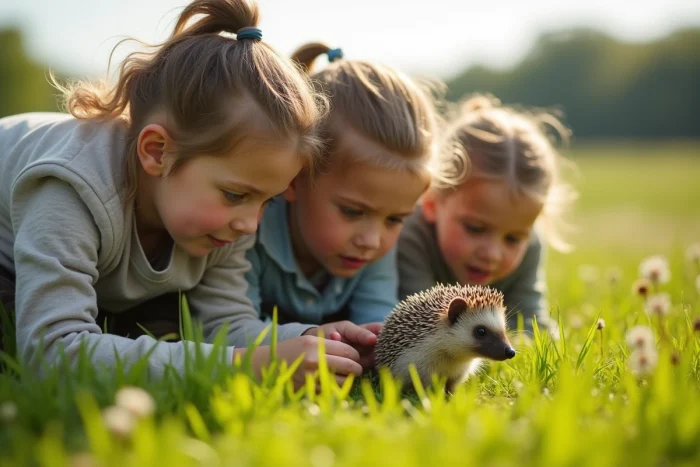
Reading and Animal Content: What Captures Families’ Attention
The animal content sector (books, documentaries, specialized websites) increasingly targets families with children. Animal stories remain a preferred reading medium among young readers, a fact that publishers have long exploited but which takes on a new dimension with digital formats.
Stories about wild or domestic animals often serve as gateways to more complex topics: ecology, ethics, biology. An article on the social behavior of elephants can lead a ten-year-old reader to question the notion of family among mammals, and then on the threats facing their habitat.
However, the proliferation of “incredible facts” content on social media poses a reliability problem. Spectacular claims circulate without sources, and verification remains the exception. For a parent or teacher, distinguishing documented content from an approximate viral list requires increasing effort.
Access to reliable information about animals, whether it concerns health advice for a cat, news on the conservation of wild species, or documented stories, ultimately relies on the choice of sources. Editorial structures that combine veterinary expertise, scientific data, and field narratives offer a filter that algorithmic feeds do not yet replace.