
On a Peugeot 308, one winter morning, the dashboard displays “Electrical circuit fault” and the car refuses to start. The multimeter placed on the battery indicates a correct voltage, and the terminals are clean. The problem does not come from the battery, but from the box placed right on top: the BPGA, or Power Protection and Management Box.
This component distributes current to the control units and protects the circuits via its integrated fuses and relays. When it malfunctions, the symptoms spread out and the diagnosis goes in circles.
BPGA and BSM: two distinct boxes not to be confused
A common mistake in the field is to look for the wrong diagram. In a vehicle like the Peugeot 3008, the BSM (Engine Servitude Box) manages the fuses and relays in the engine compartment. The BPGA, on the other hand, is located directly on or near the battery, in a separate plastic box.
The two parts have neither the same location nor the same functions. The BSM powers the high-current circuits (fans, fuel pump), while the BPGA protects and distributes power to the vehicle’s electronic control units: airbags, lighting, air conditioning, multimedia system.
Before ordering a part or looking for a fuse diagram, check the exact reference engraved on the box. The BPGA has a manufacturer reference distinct from the BSM, and the two are not interchangeable. Sellers of used parts sometimes confuse the two, complicating searches. To understand how to test the BPGA box on Les Voitures Anciennes, distinguishing between these two modules is the starting point.
BPGA fuse diagram: identification and reading
The BPGA contains a printed circuit board on which fuses, relays, and sometimes current measurement components are soldered. The fuse diagram varies according to the vehicle model and equipment level. The same vehicle (for example, a Citroën C4) can have different versions of the BPGA depending on the production year and installed options.
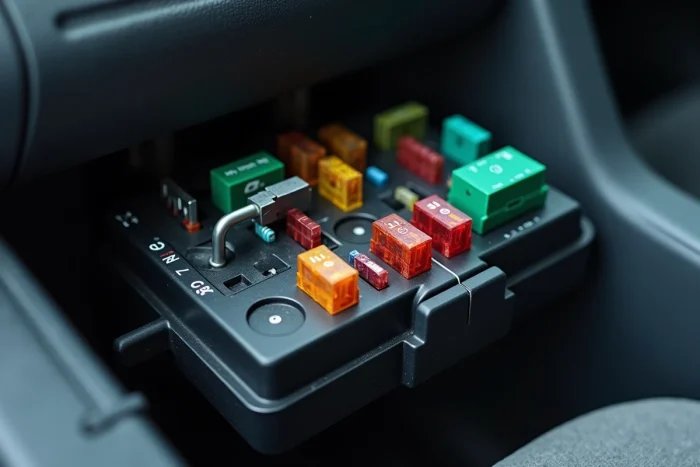
To read the diagram correctly, first locate the cover of the box. On most Peugeot and Citroën models, a diagram is molded or glued on the inner face of the cover. Each fuse location corresponds to a specific circuit.
The fuses in the BPGA are not all of the same type. Generally, you will find:
- Standard blade fuses, protecting accessory circuits (interior lighting, auxiliary sockets)
- Midi or maxi blade fuses, for high-intensity circuits (starter, main power supply to the control unit)
- Integrated relays, which switch the power supply of certain consumers according to the commands from the engine control unit
A visually intact fuse can be faulty: continuity is checked with a multimeter in ohmmeter mode, with the fuse removed. A simple visual inspection is not sufficient, especially on midi fuses where the internal break is not always visible.
Testing a BPGA box with a multimeter: field traps
The classic test involves measuring the voltage at the output of the BPGA, with the engine off and then running. Place the positive probe on the output terminal of the concerned fuse, and the negative probe on the chassis ground. With the engine off, you should find the battery voltage. With the engine running, the voltage should rise slightly due to the alternator.
The trap is that on recent models, the alternator voltage is controlled by the engine control unit. Intelligent charging modulates the voltage setpoint based on driving style, battery condition, and active consumers (air conditioning, defrosting, heated seats). A voltage that fluctuates between different values can therefore be perfectly normal.
Before concluding a BPGA failure, check these points:
- The battery voltage at rest, with the ignition off for at least two hours, to eliminate a weak battery
- The condition of the terminals and contacts on the box: oxidation on the BPGA connections causes intermittent voltage drops
- The vehicle’s resting current, by placing the multimeter in series on the negative terminal of the battery: an abnormally high resting current may indicate a stuck relay in the BPGA
- The reading of fault codes via a diagnostic tool, particularly code B1624 which points directly to a malfunction of the box
The case of a stuck relay
A stuck relay in the BPGA keeps a circuit powered at all times. The battery drains in a few days, or even hours. This is detected by excessive resting current, but sometimes also by a slight audible click when disconnecting and reconnecting the battery. Replacing the battery without checking the BPGA condemns the new battery to the same fate.

BPGA failure: a recognized weak point on certain Peugeot and Citroën models
On models like the Peugeot 308, the 3008, or the Citroën C4, BPGA failure is documented as a recurring problem. On the 308 GTi 270, the preventive replacement of the box is even presented as a selling point in the used car market, a sign that the failure is recognized as a structural weak point by informed owners.
Feedback varies on this point according to generations and usage conditions, but the failure pattern often remains the same: progressive oxidation of the solder joints on the printed circuit board, relays that eventually stick, or internal fuses that fail without visible external signs.
Repair or replacement of the BPGA
Some specialized workshops offer repair of the printed circuit board (re-soldering, relay replacement). This option costs less than a new box, but requires a precise diagnosis of the faulty component. A used BPGA can also do the job, provided that compatibility with the vehicle and equipment level is verified.
After replacement, a reset via the diagnostic tool is usually necessary for the control unit to recognize the new box and restore charge management.
The BPGA remains a discreet component under the hood, but when it fails, the entire electrical chain suffers. Correctly identifying the box, reading its fuse diagram, and mastering the subtleties of intelligent charging before pulling out the multimeter: this is the difference between a successful diagnosis and a series of unnecessary replacements.