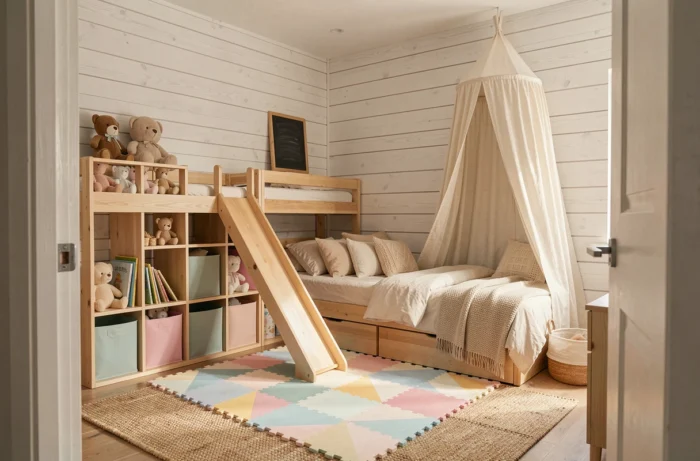
Designing a playful and safe children’s room involves balancing constraints that are rarely addressed together: furniture safety standards, indoor air quality, and the actual needs of the child according to their stage of development. Online content often focuses on decoration or storage but overlooks recent regulatory aspects and the practical trade-offs that determine daily safety.
Air Quality and Materials: The First Invisible Setup
Before choosing a bed or wall color, the air quality in the room deserves special attention. For a nursery or young child’s room, paints with very low emissions of volatile organic compounds (VOCs), marked with A+ or the European Ecolabel, reduce exposure to indoor pollutants from the very first nights.
This point goes beyond mere aesthetic preference. A new particle board furniture piece can emit formaldehyde for several weeks. Ventilating the room before placing the child in it, ideally for several days after painting or the arrival of new furniture, remains the most effective precaution.
The floor also plays a direct health role. A washable and phthalate-free covering (natural linoleum, oiled hardwood with low emissions product) limits the accumulation of dust and allergens at ground level, where young children spend most of their time. Specialized catalogs like those offered on kids-paradise.fr allow filtering furniture and accessories according to these health safety criteria.
Bunk Beds and EN 747 Standards: What the 2024 Revision Changes
The choice of sleeping arrangement is often the first aspect of the setup. Crib for toddlers, Montessori-inspired floor bed, loft bed, or bunk bed to save space: each option involves distinct safety constraints.
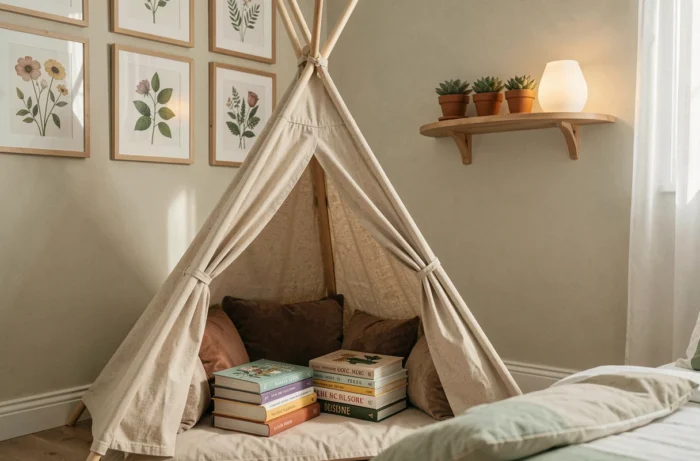
The European standards EN 747-1:2024 and EN 747-2:2024, published in March 2024, strengthen requirements for stability, structural strength, and safety of barriers, ladders, and platforms for bunk beds and loft beds. These revisions impose stricter testing on manufacturers, but they are only valuable if the consumer verifies compliance at the time of purchase.
High Sleeping Arrangements: Maturity Takes Precedence Over Age
The DGCCRF recommends not using the upper sleeping area before the age of 6. This limit is based on the child’s ability to climb up and down a ladder independently, to follow safety instructions, and not to fall during sleep.
In practice, the age indicated by the manufacturer is not sufficient. A particularly restless 6-year-old does not present the same risk profile as a calm child of the same age. The DGCCRF also advises regularly checking the tightness of screws, the presence of all parts, and the installation of the anti-tip device when provided. This ongoing check, not just at assembly, is rarely mentioned in setup guides.
- Check for compliance with EN 747 standards on the label or product sheet before purchase
- Check the tightness of fasteners every three to six months, especially on solid wood beds that expand and contract with humidity
- Install the anti-tip wall device provided by the manufacturer, even if the bed seems stable when empty
- Remove any furniture, shelf, or object accessible from the upper sleeping area to prevent falls related to climbing
Child’s Room Zoning: Delimiting Without Partitioning
A child’s room fulfills at least three functions: sleeping, playing, and concentrating (reading or calm activities). Visually delimiting these areas helps the child associate each zone with a behavior, without the need for physical partitions.
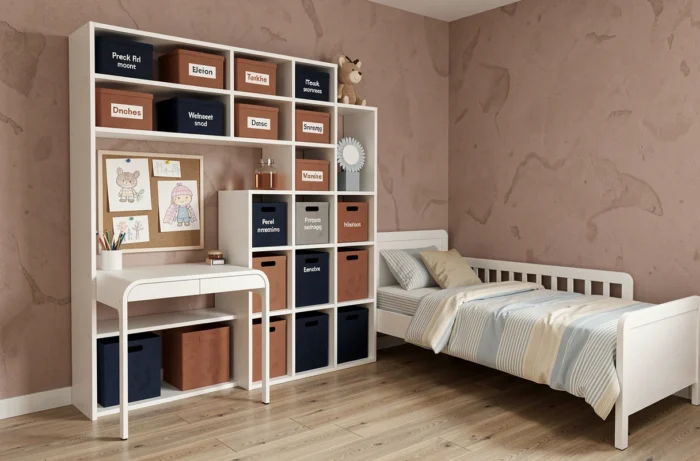
A thick play mat is enough to mark the play area. A small low furniture piece, oriented perpendicular to the wall, can separate the reading corner from the rest of the room while also serving as storage. Zoning relies on furniture and flooring, not on walls.
Accessible Storage: An Underestimated Lever of Autonomy
Placing toy bins and low shelves at child height is not just about practicality. A child who can store and find their belongings independently develops a form of concrete autonomy in their space. Closed storage (heavy-lidded chests, high cabinets) creates dependence on adults and, in the case of chests, a risk of finger or head pinching.
- Prefer open bins or those with light lids, without locking mechanisms accessible to the child
- Secure any high shelf or furniture to the wall with anti-tip brackets, even low furniture
- Limit the number of visible toys to reduce sensory overload and facilitate independent storage
Colors and Visual Stimulation in the Child’s Room
The choice of colors influences the atmosphere perceived by the child, but available data do not allow for a conclusion about a direct and measurable effect of a specific shade on sleep or behavior. Decoration recommendations are based more on professional consensus than on robust clinical studies.
What is documented, however, concerns the VOCs emitted by paints: the choice of color matters less than the choice of product. A bright paint rated A+ exposes the child to fewer pollutants than a pastel paint without a label.
For wall decoration, removable elements (repositionable stickers, lightweight frames fixed out of reach) allow for visual evolution without repainting. This is a practical advantage when the child’s tastes change every two years.
Ultimately, designing a playful and safe children’s room relies on technical checks that are not particularly spectacular: compliance of furniture, air quality, wall fixings, and regular monitoring. These points, less photogenic than a rainbow wall, nonetheless determine the real safety of the space on a daily basis.