
A commute of a few kilometers on a motorcycle, repeated five times a week, stresses the battery in a way that long weekend rides do not replicate. Between cold starts, riding times that are too short for a full recharge, and overnight immobilization periods, your motorcycle battery endures a regime that accelerates its aging much faster than one might think.
Sulfation and chronic undercharging on motorcycles: the real wear mechanism
On a short daily commute, the engine rarely runs long enough for the alternator to compensate for the energy consumed during starting. You start, ride for ten minutes, then turn off. The next day, it’s the same routine.
This pattern keeps the battery in a state of permanent undercharging. A lead-acid battery that never returns to full charge gradually develops sulfation: lead sulfate crystals form on the plates and become increasingly difficult to dissolve. The phenomenon is silent, but it reduces the usable capacity week after week.
When discussing motorcycle insurance, the state of the battery is rarely considered. However, running out of electrical power in the middle of a morning commute remains one of the most common reasons for assistance calls for two-wheelers used in the city.
On a gasoline-powered motorcycle, the alternator produces current proportional to the engine speed. In urban traffic, with prolonged idling phases in traffic jams, the electrical production remains lower than the consumption of accessories (injection, dashboard, lights). Therefore, the energy balance of each trip can be negative.
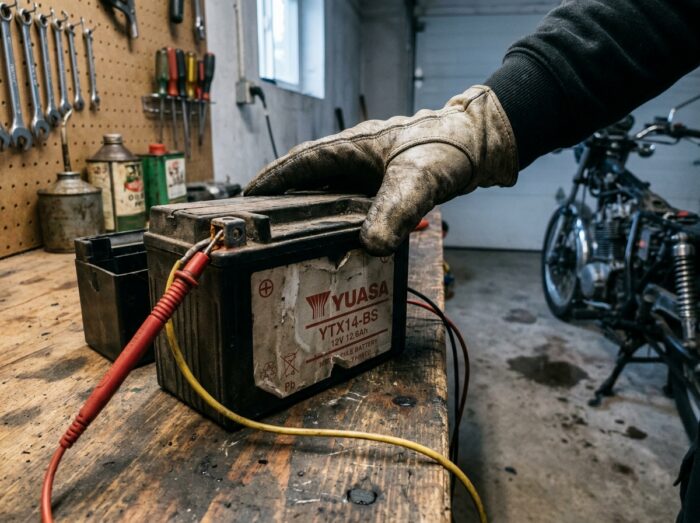
Motorcycle battery and cold starting: why winter mornings count double
Cold starting is the moment when the battery provides the most energy in a very short time. At low temperatures, the internal resistance of the battery increases, meaning it has to work harder to deliver the same current to the starter.
In winter, two constraints accumulate:
- The engine faces greater mechanical resistance due to the thicker oil, which lengthens the starting phase and puts more strain on the battery.
- The chemical capacity available in a lead-acid battery significantly decreases when the temperature drops, reducing the mobilizable energy reserve.
- The following trip is often too short to compensate for this peak in consumption, especially if the motorcycle is parked outside and the engine takes time to reach its optimal thermal regime.
A rider who makes two cold starts a day (morning and evening) during the cold months imposes a cyclic stress on their battery that manufacturers do not factor into their lifespan estimates. These estimates generally rely on usage conditions that include longer rides.
Maintenance charger for motorcycle battery: the only reliable solution
Relying on daily riding to keep the battery in good condition is a losing bet when trips are less than twenty minutes. The operational solution is the maintenance charger, also known as a smart charger or battery maintainer.
How a maintenance charger works
Plugged in between uses (typically at night), it detects the charge level and injects a low current to bring the battery back to full capacity without the risk of overcharging. A regular complete recharge cycle prevents sulfation from becoming permanent.
Feedback varies on the ideal frequency of connection: some riders leave the charger connected every night, while others limit it to two or three times a week. What is agreed upon is that never compensating for undercharging significantly shortens the battery’s lifespan.
Criteria for choosing a suitable charger
- Check compatibility with the type of battery (traditional lead-acid, AGM, gel, or lithium). A charger designed for lead may damage a lithium battery, and vice versa.
- Prefer a model with automatic shut-off and a maintenance mode (float mode), which prevents any overcharging even in case of forgetfulness.
- Opt for a device with a power suitable for the battery’s capacity: a charger too powerful for a small scooter battery can cause excessive heating.

Battery digital passport: the EU regulation that will change everything
The European regulation 2023/1542 requires that, starting in August 2024, batteries for light vehicles (the so-called “light means of transport” category, which includes some electric motorcycles and scooters) be accompanied by information on their performance and durability: capacity, capacity loss, internal resistance, expected lifespan.
Starting in February 2027, each affected battery will need to have an individual digital passport. This document will record the number of cycles performed, negative events (deep discharges, exposure to extreme temperatures), and the charge state history.
For urban riders using an electric vehicle daily, this means that the real impact of short trips on the battery will be traceable and documented. A used vehicle buyer will be able to consult this data and see if the vehicle has suffered years of chronic undercharging or repeated starts without a full recharge.
Daily commuting habits will have a direct influence on the resale value of electric motorcycles covered by this regulation. It is no longer just a matter of comfort or reliability; it is a measurable economic parameter.
Real autonomy and battery wear: adapting commuting habits
One cannot always extend their trip to recharge the battery, but a few concrete adjustments can limit the damage. Riding at a slightly higher engine speed during the last minutes of the trip (without excess) allows the alternator to produce more current. Turning off unnecessary consumers (heated grips, GPS) during short trips also reduces the energy deficit.
On an electric scooter or motorcycle, keeping the battery between an intermediate charge threshold rather than letting it drop very low before replugging preserves its longevity. Avoiding repeated deep discharges remains the most protective rule for both lithium-ion and lead-acid chemistry.
The daily motorcycle commute is not a problem in itself. It is the lack of compensation, the accumulation of undercharges, and exposure to cold without appropriate maintenance that transforms a new battery into a tired one in just a few seasons. A regularly plugged maintenance charger costs a fraction of the price of a new battery, and it is the only measure that truly changes the game.