
Maintaining a home is not just about vacuuming and emptying the trash. Households that keep a functional interior over time share a common trait: they treat cleaning as a system, not as a one-off chore. Organizing and maintaining your home relies on precise technical choices, from air quality to task sequencing.
Indoor pollution and maintenance: what your cleaning products really release
Cleaning with a scented multi-purpose spray or lighting an incense stick after cleaning may seem harmless. However, Anses and the Indoor Air Quality Observatory (OQAI) warn about the significant increase in volatile organic compounds (VOCs) and fine particles caused by these practices.
Indoor air fresheners, scented candles, and aerosol cleaners are among the top sources of household pollution. Ventilating for at least ten minutes after each cleaning session remains the most effective recommendation for eliminating these pollutants, well before considering the purchase of an air purifier.
We recommend reducing the number of products stored under the sink. A fragrance-free multi-surface cleaner, white vinegar, baking soda, and black soap cover nearly all the needs of a household. Fewer products mean fewer VOCs emitted and less storage space taken up.
- Replacing sprays with solutions poured onto a microfiber cloth reduces the spread of airborne particles
- Products labeled “European Ecolabel” limit the concentration of irritating substances, a criterion that can be verified on the packaging
- Storing cleaning products in a ventilated cupboard, never under a closed and damp sink, prevents the accumulation of chemical vapors
Several households consulting home tips on Oh Brico find that a strict sorting of cleaning products simplifies both storage and the cleaning routine.
Household task management apps: Tody, OurHome, and the end of paper lists
Planning cleaning with a paper list or a magnetic board on the fridge has a structural weakness: it does not adapt to the actual frequency of dirt in each room. Dedicated apps change the game.
Tody works by progressively deteriorating each area. Instead of a fixed list (“Monday: kitchen, Tuesday: bathroom”), the app calculates a priority level based on the last cleaning date and the frequency you have set. The kitchen rises to the top faster than the guest room, which aligns with actual usage.
OurHome takes a different approach: distributing tasks among household members with a points system. Each completed task earns points visible to all, making the cleaning load transparent. For households with children, this mechanism turns tidying up into a concrete mission rather than a vague injunction.
We observe that adopting a digital tool only works if the initial setup is realistic. Overestimating the cleaning frequency in the app generates a stream of ignored notifications in less than two weeks. It’s better to set slightly longer intervals than the theoretical ideal, then adjust upwards.
Cleaning sequencing by area: the method that avoids redoing everything
Always clean from the farthest point from the door towards the exit may seem basic, but most households proceed in the reverse order without realizing it. By starting from the back of the room and moving towards the door, you never go over a surface that has already been treated.
Vertical sequencing is just as important as horizontal sequencing. Dusting high shelves before vacuuming the floor prevents dirt from settling on what has just been cleaned. This top-to-bottom principle applies to every room without exception, including the bathroom where limescale splashes on the mirror fall back onto the sink.
Kitchen and bathroom: two distinct maintenance logics
The kitchen accumulates suspended grease that settles on all horizontal surfaces. A quick daily wipe of the countertop and stove after each meal prevents ingraining. Fresh grease comes off with hot water, ingrained grease requires an alkaline degreaser, which multiplies cleaning time by three or four.
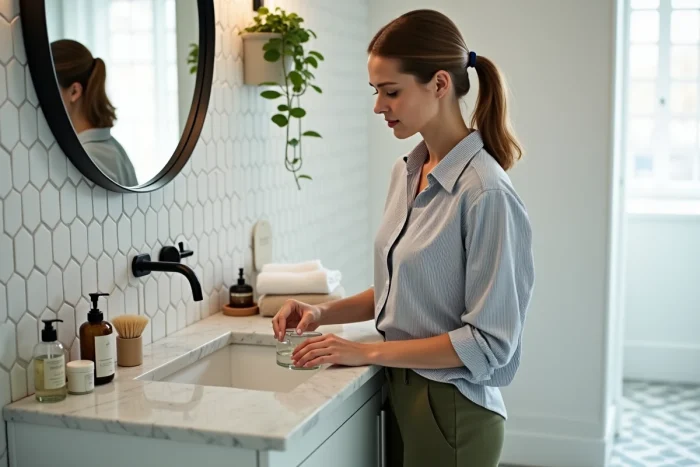
The bathroom operates on a different cycle, dominated by humidity and limescale. Scraping the shower wall after each use with a silicone squeegee takes a few seconds and postpones intensive descaling by several weeks. The most cost-effective investment in this room remains proper ventilation: an extractor that runs for at least twenty minutes after a shower limits the formation of mold on the joints.
Functional storage: sizing the container before sorting the content
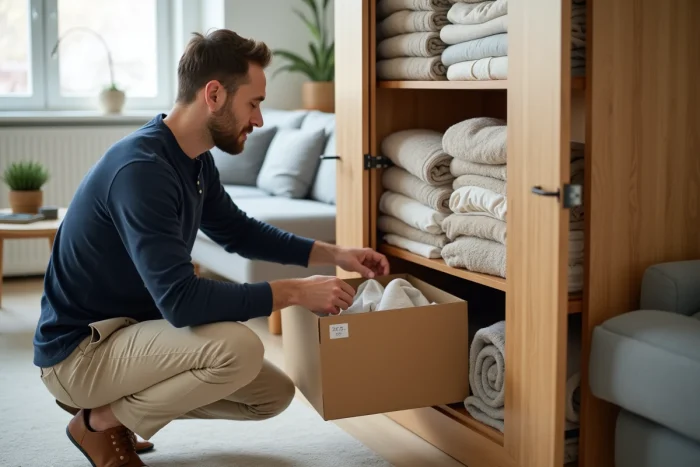
Most storage guides start with sorting. We take the problem the other way around: measuring the available space before deciding what to keep forces realistic trade-offs. A 60 cm deep cupboard will never hold as much as a 120 cm dressing room, regardless of the chosen stacking box system.
Vertical storage (shelves, hooks, magnetic bars) utilizes the height of walls, often underused in kitchens and entryways. Installing a magnetic bar for knives frees up an entire drawer. Hanging pots clears a lower cupboard that can accommodate bulky appliances.
A storage solution that works over time follows a simple rule: each item has a defined place and returns there after use. This principle seems obvious, but it fails as soon as the location is poorly thought out. The toaster used every morning should not be stored in a high cupboard. Storing an item where it is used reduces unnecessary movements and diffuse clutter.
Maintaining and organizing a home is more about designing a system than individual willpower. Good sequencing, limited products, a suitable tracking tool, and storage sized to the actual space yield lasting results, without extra effort over the weeks.