Wearing a balaclava under a motorcycle helmet is a common reflex in cold weather or to enhance riding comfort. However, this habit raises specific questions regarding legality and safety. The motorcycle balaclava is not just a simple textile accessory: its choice, fit, and the context in which it is worn can have concrete consequences, including with an insurer after an accident.
Motorcycle balaclava and face concealment: what French law says
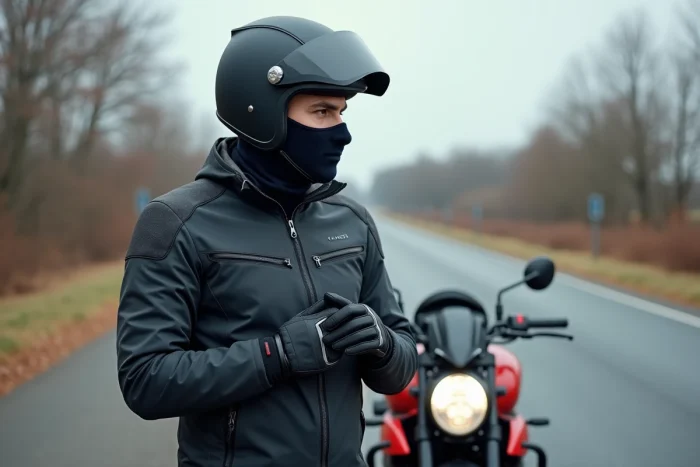
In France, the intentional concealment of the face in public spaces can be penalized if it is not justified by a legitimate reason. Riding a motorized two-wheeler is one of those recognized reasons. As long as you are riding with your helmet securely fastened, wearing a balaclava under the helmet is considered legitimate.
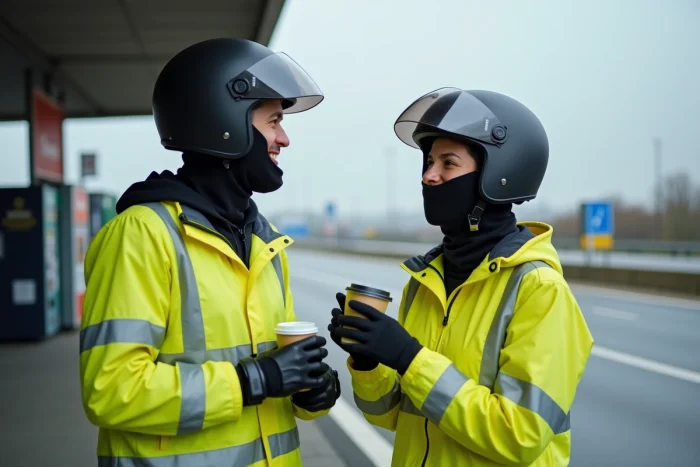
The problem arises when you stop. If you keep your balaclava on after getting off the motorcycle, for example when entering a gas station or remaining in a parking lot during a gathering, the situation changes. Recent ministerial responses remind us that this behavior can fall under the laws prohibiting identity concealment, especially in cases of public disorder.
To delve deeper into the legality of the motorcycle balaclava, it is essential to clearly distinguish between the riding phase and the moments when the rider is on foot.
In practice, the rule is simple: remove the balaclava as soon as you are no longer in a riding situation. This avoids any ambiguity with law enforcement and protects you from unnecessary fines.
Fitting the balaclava under the helmet: a protection issue often overlooked
Have you ever noticed that some helmets seem to move more when wearing a thick balaclava? It’s not just an impression. Biomechanics experts now mention the presence and type of balaclava in serious accident reports.
Why a poorly chosen balaclava worsens an impact
A balaclava that is too thick or made of slippery material creates a mobile layer between the skull and the helmet’s inner shell. At the moment of impact, the helmet may rotate on the head instead of absorbing energy properly. This rotation phenomenon is one of the factors that technical experts consider as aggravating in insurance cases.
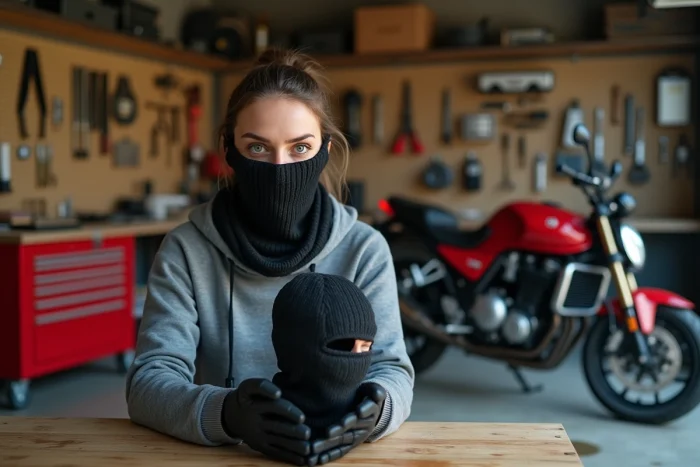
Conversely, a thin, breathable, and well-fitted balaclava keeps the helmet in place without altering its behavior in the event of a shock. The fabric should conform to the skull without creating folds or excess material at the forehead or neck.
Concrete criteria for choosing a suitable balaclava
- Prefer a thin and stretchy fabric, such as microfiber or technical material, that does not slip against the helmet’s inner foam.
- Ensure that the balaclava does not form any folds once the helmet is on: run your fingers between the fabric and the foam to detect any excess material.
- Choose a cut that provides a clear field of vision and does not ride up under the eyes, even after several minutes of riding.
- If you wear a modular helmet, test the balaclava with the chin guard raised and lowered to ensure it does not interfere with the mechanism.
The right test: put on the helmet and balaclava, then shake your head side to side. If the helmet moves more than usual, the balaclava is too thick or too smooth. Change the model.
Motorcycle balaclava and insurance: what can work against you
After an accident, the insurer assigns an expert to reconstruct the circumstances of the incident. The presence of a balaclava is now part of the elements recorded in the report, alongside the condition of the helmet or the wearing of gloves.
Two scenarios emerge. If the assessment shows that the balaclava worn was thick, poorly fitted, and that the helmet experienced abnormal rotation during the impact, this element can be considered an aggravating factor. This does not automatically mean a denial of compensation, but it complicates the case and may reduce coverage for head injuries.
If, on the contrary, the balaclava is thin and properly worn, it poses no problem. Some experts even note that it can limit skin abrasions on the neck in case of a slide.
Riding safely with a motorcycle balaclava: mistakes to avoid
The balaclava is not protective equipment in the regulatory sense. It does not replace an approved helmet, mandatory gloves, or an appropriate jacket. Its role remains that of a thermal comfort and hygiene supplement (it protects the helmet’s inner foams from sweat).
Some mistakes frequently occur among motorcyclists:
- Keeping a balaclava damp with sweat during a long ride: the wet fabric cools the neck through evaporation and can cause discomfort that distracts attention.
- Using a thick cotton balaclava under a jet helmet: cotton absorbs moisture, dries slowly, and the extra volume reduces the lateral support of the helmet.
- Neglecting washing: a balaclava worn for several outings without maintenance accumulates bacteria and odors, prompting some motorcyclists to loosen the helmet to “breathe,” reducing protection.
Wash the balaclava after each extended outing, at low temperature, and let it air dry. Have a spare balaclava ready if you ride several days in a row.
The last point to keep in mind concerns visibility. In rainy or extremely cold weather, the fog generated by breathing through certain balaclavas can fog the visor more quickly. Models with a breathable panel at the mouth limit this phenomenon, making the road safer without sacrificing thermal protection for the face.