We arrive in Lyon for a weekend, open a reservation app, and the question comes up quickly: bouchon lyonnais or brasserie? Both promise traditional cuisine, generous dishes, and local wine. The problem is that the line between these two formats has seriously blurred in recent years, to the point that some establishments claim both labels at once.
The setting and service at a bouchon lyonnais versus a brasserie
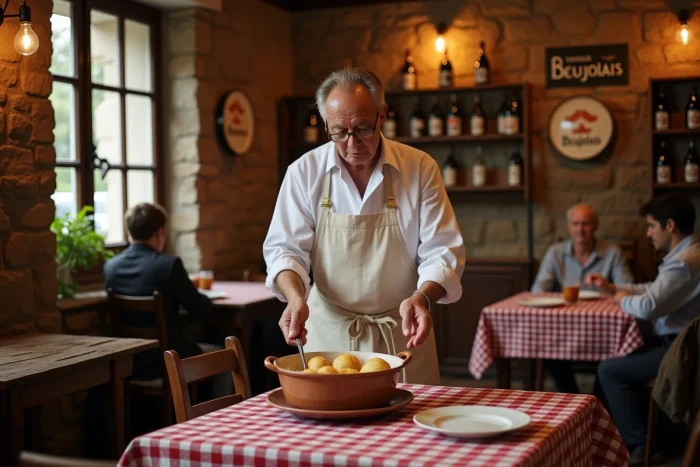
When you push open the door of a bouchon, you enter a room rarely larger than a living room. Tight tables, checkered tablecloths, walls covered with old posters. The service is more about conversation than protocol: you are sometimes addressed informally, the dish being served is commented on, and a bottle of Beaujolais is opened without asking.
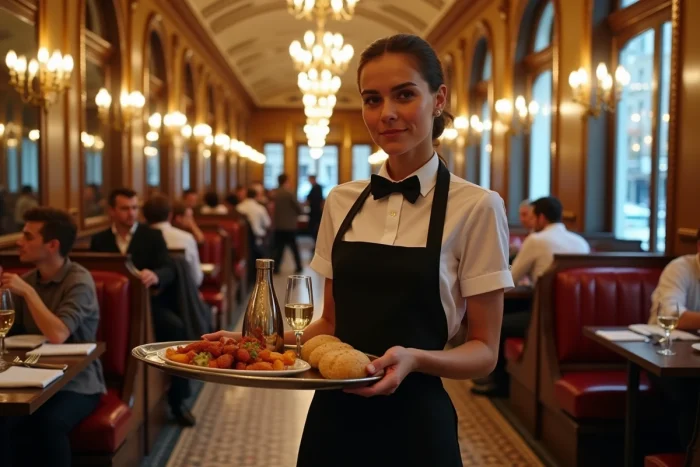
The Lyonnaise brasserie operates on a different level. A larger room, a longer menu, continuous hours that allow for dining at 3 PM on a Sunday. The service remains friendly, but it follows a faster pace, designed for a higher volume of customers.
To find the definition of a bouchon lyonnais on Mon Assiette, it quickly becomes clear that the atmosphere is an integral part of the meal, not just the contents of the plate. The bouchon experience is lived as much in the atmosphere as in the cuisine.
Bouchon menu and brasserie menu: what changes on the plate
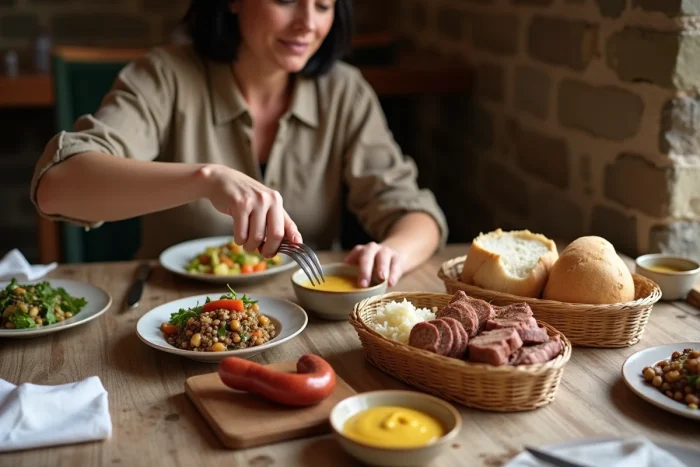
A serious bouchon lyonnais revolves around about ten dishes, rarely more. Pike quenelle, tablier de sapeur, cervelle de canut, andouillette, Lyonnaise salad. The menu changes only slightly with the seasons. You don’t choose a bouchon for variety; you go there to eat a specific repertoire, cooked with local products.
The brasserie offers a broader spectrum. You can find Lyonnaise dishes, but also a salmon steak, a rib-eye with fries, sometimes a risotto. This diversity is an advantage if your table includes a vegetarian or someone who doesn’t like offal.
The dishes that make the difference
- The tablier de sapeur (breaded and fried tripe) almost never appears on a brasserie menu, as its preparation is lengthy and its clientele is targeted
- The cervelle de canut, this whipped cheese with herbs, is a direct marker of the bouchon: it is served at the end of the meal, not as a starter
- Pike quenelles can be found in both formats, but at a bouchon they are often homemade, while in a brasserie the industrial version remains common
The depth of the Lyonnaise repertoire is better measured in a bouchon. In a brasserie, regional dishes coexist with a standardized menu that dilutes culinary identity.
Bouchon lyonnais label: a reliable marker or a marketing argument?
Lyon has established a label “Les Bouchons Lyonnais” to certify establishments that adhere to a specific set of criteria: traditional recipes, regional products, ambiance in line with tradition. On paper, it’s a useful filter.
In practice, not all good bouchons carry this label, and some labeled ones rely a bit on the tag. The label guarantees a foundation of tradition, not the quality of execution. It is recommended to check the menu displayed in the window before entering: if it exceeds twenty dishes or offers burgers, you are no longer really in the bouchon realm.
Concrete signals to spot a true bouchon
- A short menu, handwritten or printed on a simple sheet, with dishes that change little
- A unique menu or a limited choice of two or three starters, main courses, and desserts
- Beaujolais or Côtes-du-Rhône served in a pot (the famous Lyonnaise pot of 46 cl) rather than an endless wine list
- A small room where neighboring tables are close enough to hear the conversation next door
Gastronomic bouchon and modern brasserie: the fading line in Lyon
The MICHELIN Guide describes a new generation of Lyonnaise chefs who maintain the bouchon spirit (hearty dishes, conviviality) while lightening recipes, incorporating more vegetables, and opening up to external influences. The result is the emergence of hybrid establishments, sometimes called “gastronomic bouchons.”
Maison Léa, for example, presents itself on TheFork as a “gastronomic bouchon” with a more polished decor and a more formal service than the classic bouchon. You can find the Lyonnaise repertoire there, but in a setting that resembles a chic brasserie more. These hybrid addresses blur the traditional distinction, and that’s precisely what complicates the choice for someone visiting Lyon for the first time.
Feedback varies on this point: some regulars believe these establishments betray the spirit of the bouchon, while others see it as a logical evolution of a format that must adapt to survive. What doesn’t change is that the foundation remains Lyonnaise, with quenelles, sausage, and cervelle de canut.
Choosing between bouchon and brasserie in Lyon: the criteria that matter
The choice depends less on a hierarchy of quality than on what you expect from the meal. If you come to Lyon to experience immersion in traditional Lyonnaise cuisine and atmosphere, the bouchon is a must. The narrow room, the short menu, the pot of Beaujolais: everything contributes to a coherent experience.
If the group has very different tastes, if you want to eat at an off-peak time, or if you prefer a larger room with a view of the Saône quays, the brasserie offers more flexibility. You can eat well without risking encountering a dish of tripe that divides the table.
A final criterion often overlooked: reservations. Labeled bouchons fill up quickly, especially on weekends. Booking two to three days in advance remains the norm for rated bouchons. Brasseries, with their higher capacity, handle spontaneous demand better.