
Managing family life often feels like a balancing act. Between irregular schedules, meals to prepare, and homework to supervise, the mental load weighs heavily on those who plan. However, two recent topics are changing the game for French families: the legal framework surrounding children’s images online and the specific needs of blended families. These angles, still rarely addressed in traditional guides, deserve our attention.
Children’s Right to Image and Social Media: What the Law Changes
Have you ever posted a photo of your child on social media without a second thought? Since June 2023, France has a law regulating commercial influence. It strengthens the protection of minors’ right to image on digital platforms.
Specifically, publishing content featuring your children for commercial purposes (sponsored videos, product placements) is now subject to specific obligations. The income generated from this content must be partially allocated for the benefit of the child. The minor can also request the removal of their images.
This phenomenon has a name: sharenting, a contraction of “share” and “parenting.” Even outside of a commercial context, the regular sharing of children’s photos raises the question of consent. A four-year-old cannot give informed consent regarding the publication of their photo in front of thousands of people. Resources dedicated to family life, such as the Bridge News family site, regularly discuss these legal developments and their practical implications.
Before publishing, ask yourself three questions: would your child be embarrassed by this image in ten years? Does the background reveal any personal information (school, address)? And most importantly, does this publication serve your child or your own need to share?

Blended Families: Harmonizing Rules Between Two Households
Support structures for parenting (parent cafés, family mediation, Faber and Mazlish workshops) have reported a notable increase in requests related to blended and co-parenting families since 2023. The difficulties reported are very concrete: conflicting schedules, different educational rules from one household to another, complicated communication with an ex-spouse.
A Child, Two Living Environments
A child who moves from a household where bedtime is set at 8:30 PM to another where no one monitors the time experiences a destabilizing shift. The problem is not just that the rules differ. It is the complete lack of consistency on fundamental benchmarks that creates insecurity.
Three points deserve a minimal agreement between the two households:
- Sleep schedules during the week, to maintain the school rhythm and concentration in class.
- Daily screen time, specifying which devices are accessible and at what times.
- Responses to risky behaviors (repeated lying, bullying, early substance use), so that the child does not exploit the gaps between two authorities.
Family mediation, offered by CAF or accredited associations, provides a neutral framework for establishing these agreements. It is not couples therapy; it is a practical negotiation tool.
Family Mental Load: Going Beyond a Simple To-Do List
Surveys published between 2022 and 2024 by institutes like IFOP or Drees document a trend: fathers working from home are participating more in household tasks. Nevertheless, the imbalance persists, mainly regarding the invisible part of family work: planning, anticipating, remembering.
Washing the dishes is visible. Remembering that the stock of diapers is running low, that the orthodontist appointment falls on a strike day, that the lunch form must be sent back before Friday—this is the mental load. And it remains predominantly carried by mothers.
The Weekly Family Meeting
Some parenting specialists recommend a simple practice: the weekly governance family meeting. The principle is straightforward. All household members (children included, as soon as they can read) meet for fifteen minutes to review the upcoming week.
Why does it work better than a shared list app? Because the meeting makes planning collective. The child who knows that Wednesday is busy understands why they cannot go to the park that day. The partner who hears the list of medical appointments becomes aware of the volume to manage.
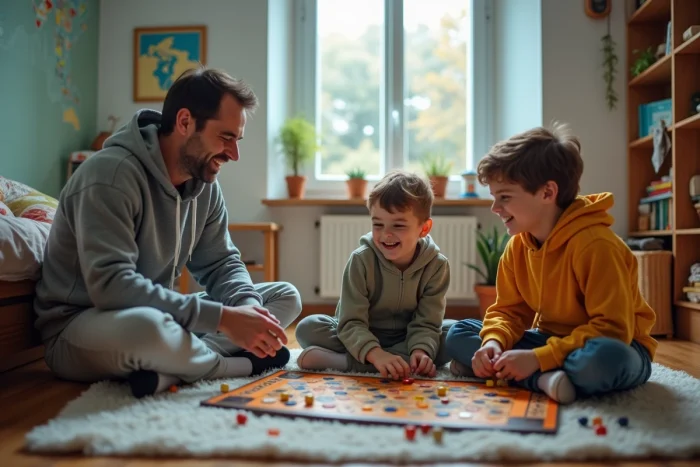
Here’s what this meeting can cover:
- The fixed appointments for the week (doctor, activities, school meetings) and who is responsible for them.
- The planned meals, to avoid the daily question “what are we eating tonight” and do the shopping all at once.
- A review of what went wrong the previous week, without blame, seeking a concrete adjustment.
Family Life and Current Affairs: Staying Informed Without Overload
Parents’ rights, CAF assistance, changes in parental leave, health regulations in daycare: these topics change regularly. Keeping up with family news prevents missing out on a right or assistance.
The trap is information overload. Multiplying sources (Facebook groups, forums, newsletters) often produces more anxiety than clarity. It’s better to select two or three reliable sources, check that they cite their legal references, and stick to them.
Family associations (UDAF, UNAF) publish practical sheets updated with each legislative change. They cover both consumer issues and rights related to child custody or disability situations.
Family life is not just about organizational tips. It involves educational choices, ongoing adjustments, and attention to legal developments that directly affect children. Maintaining a clear framework on the right to image, structuring co-parenting when two households coexist, and making family planning visible to all household members: these are three concrete levers that change daily life far more than yet another list of good resolutions.