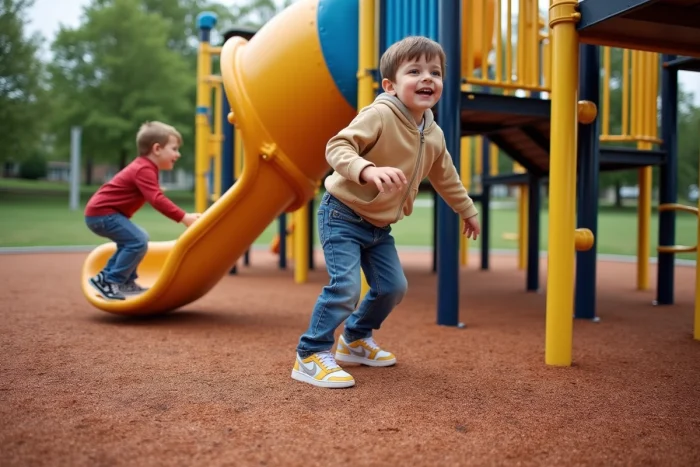
When evaluating the safety of a playground, attention is often focused on the equipment: the height of the slide, the attachment of the swing, the spacing of the rungs. The ground, however, often remains a secondary parameter in the analysis.
Recent control data shows that the shock-absorbing surface has become the leading cause of non-compliance detected during annual inspections, surpassing the equipment itself. Comparing the types of surfaces based on measurable criteria helps to understand where the protection of children is truly at stake.
HIC Criterion and EN 1177 Standard: What a Shock-Absorbing Surface for Playgrounds Really Measures
The ability of a surface to protect in the event of a fall is not judged by touch. It is measured by the HIC (Head Injury Criterion) test, defined by the European standard EN 1177. This test simulates the impact of a child’s head on the surface from a critical fall height (HCC).
A surface is compliant if the HIC value remains below the threshold set by the standard. Beyond that, the risk of severe head trauma increases significantly. The EN 1176 standard, which governs the equipment, requires that the surface located in the impact zone meets this threshold.
The often-overlooked point: the HIC value of a surface evolves over time. A compliant surface upon installation may exceed the threshold after a few years of settling or hardening. This phenomenon is precisely what control reports from accredited organizations like Apave, Dekra, or SGS are increasingly documenting. Therefore, installing a compliant shock-absorbing surface for playgrounds is not enough if its long-term monitoring is not scheduled.
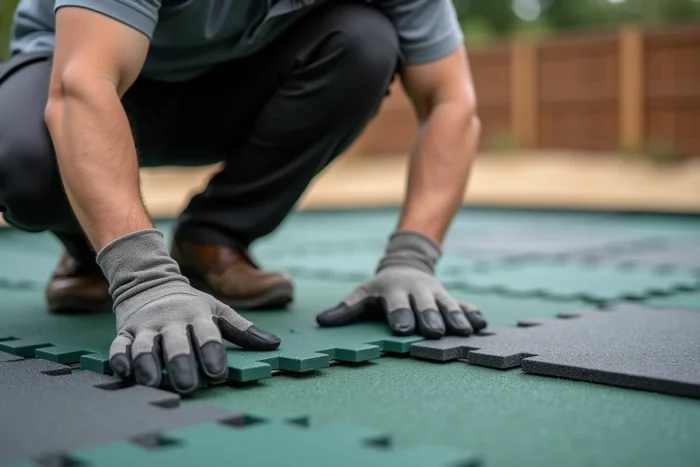
Poured Surface, Rubber Tiles, Wood Chips: Comparative Table of Surfaces
Communities and playground managers have several families of shock-absorbing materials at their disposal. Their performances differ on concrete axes: shock absorption, lifespan, maintenance, and behavior against aging.
| Type of Surface | Shock Absorption | Estimated Lifespan | Maintenance | Risk of Degradation |
|---|---|---|---|---|
| Poured EPDM Surface | High (adjustable by thickness) | Long | Regular cleaning, occasional repairs | Hardening, vandalism (fire) |
| Rubber Tiles | High | Long | Unit replacement possible | Uplifting, degraded joints |
| Wood Chips | Good (if thickness is maintained) | Short to medium | Frequent replenishment | Dispersion, compaction, mold |
| Sand | Fair (if thickness is sufficient) | Variable | Raking, disinfection | Compaction, animal contamination |
| Natural Grass | Low to fair | Variable depending on climate | Mowing, watering | Rapid wear at impact points |
The poured EPDM surface and rubber tiles offer the most stable shock absorption performance over time. In contrast, natural materials (wood chips, sand) lose their absorption capacity more quickly if maintenance is not rigorous.
What the Table Does Not Show: Actual Aging
A new poured surface easily meets HIC compliance. After several years of exposure to UV, frost, and foot traffic, the rubber granulate compacts, and the shock-absorbing layer loses its elasticity. Recent control reports indicate a significant increase in non-compliance related to this aging, even on installations less than ten years old.
Wood chips present a different problem. The minimum thickness required to guarantee absorption naturally decreases due to dispersion and decomposition. Without regular replenishment, the impact zone ends up with an insufficient layer.
Total Cost Over Ten to Fifteen Years: The Real Choice Criterion for Communities
The installation price of a surface represents only a fraction of the actual budget. Feedback from communities shows that an increasing number of decision-makers are now comparing costs over a complete cycle of ten to fifteen years.
Items to include in this analysis:
- Actual annual maintenance cost: cleaning, anti-moss treatment, localized repairs. Poured surfaces require occasional but limited interventions. Bulk materials require recurring replenishment
- Frequency of partial replacements: a cracked tile can be replaced individually, while a degraded poured surface over a large area requires more extensive repair
- Impact of deliberate degradation: vandalism by fire particularly affects rubber surfaces. Some communities include this risk in their specifications
- Cost of periodic HIC checks: regular compliance verification represents a modest budget relative to the legal responsibility of the manager
A surface that is slightly more expensive to install may be cheaper over time if its maintenance and replacement frequency is lower. This total cost logic alters the usual ranking of materials.
Manager Responsibility and Annual Control: What the EN 1176 Standard Implies
The EN 1176 standard does not only govern the design of equipment. It also defines inspection obligations that directly concern the surface. The manager of a playground (municipality, co-ownership, school) assumes responsibility if an accident occurs on a non-compliant surface.
The surface is now a priority control point during annual visits conducted by accredited organizations. Perfectly compliant equipment installed on a degraded surface does not protect children against the main risk: falling.
Concrete Signs of Degradation to Watch For
- Visible compacted areas under swings and at the slide exit, where impacts are repeated
- Development of moss or algae making the surface slippery, particularly in shaded or damp areas
- Cracks or peeling on poured surfaces, which reduce the effective thickness of absorption
These degradations do not fall under manufacturing defects. They result from normal use and climatic conditions. A planned maintenance program remains the only way to maintain compliance between two annual inspections.
The key takeaway: the shock-absorbing surface of a playground is not a one-time investment; it is a commitment to ongoing monitoring. Communities that incorporate the complete lifecycle of the surface into their initial decision reduce both the risk to children and the legal risk for the manager.