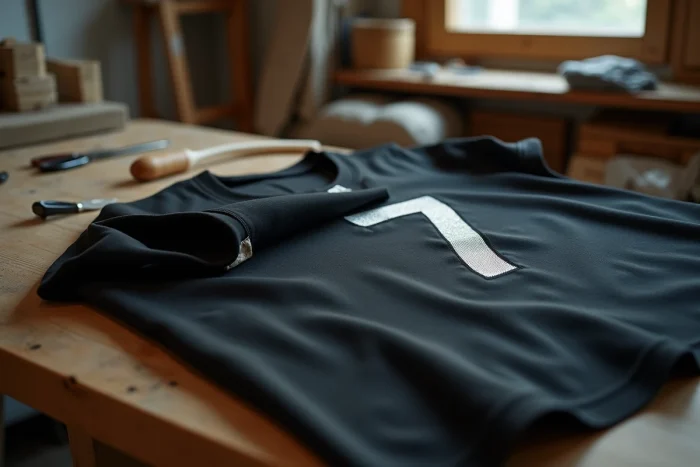
A flocking that starts to lift after a few washes raises a rarely asked question: is the problem due to the design, the fabric, or something unseen on the material? The answer involves several technical parameters, from the surface treatment of the garment to the chemistry of the hot-melt adhesive. Understanding why a flocking peels off helps avoid repeating the mistake and, in some cases, allows for salvaging a marking that is coming apart.
Invisible textile finishes: the cause of peeling that no one controls
The majority of content on the subject points to the temperature of the iron or the quality of the flex. These factors matter, but they mask a more subtle phenomenon: the finishing treatments applied in factories to the fabric.
Modern finishes (water-repellent, stain-resistant, anti-pilling, “easy-care”) create a chemical barrier between the fiber and the hot-melt adhesive of the flocking. Even with the correct temperature and proper application time, the anchoring of vinyl on treated fabric remains fragile. Residues of finishing enzymes and surfactants are identified as one of the major causes of early peeling, particularly on polycottons and polos treated against pilling.
The problem is that these treatments are rarely mentioned on the garment’s label. An organic cotton t-shirt and a stain-resistant cotton t-shirt feel similar to the touch. The difference reveals itself at the first wash after the flocking is applied, when the edges of the design begin to lift.
To identify a suspicious finish, a simple test involves placing a drop of water on the fabric before application. If the drop beads instead of being absorbed, the textile has likely received a water-repellent treatment that will hinder adhesion.
In this case, a hot pre-wash (without fabric softener) can partially reduce the finish layer, but without total guarantee. When looking to reattach a peeling flocking on Olivia Style, this parameter of finishes is indeed noted as a determining factor.
Recent hot-melt adhesives: stricter application requirements
Flocking vinyls have evolved. “New generation” adhesives tolerate modern detergents and short washing cycles better. However, their application curve (temperature, pressure, duration) is narrower than that of older products.
In practical terms, a difference of a few degrees or a few seconds less pressure is enough to compromise adhesion. Older flexes were more forgiving of approximations. New adhesives, optimized for wash durability, require a more rigorous application or they will peel off faster than their predecessors.
Iron or heat press: the choice matters
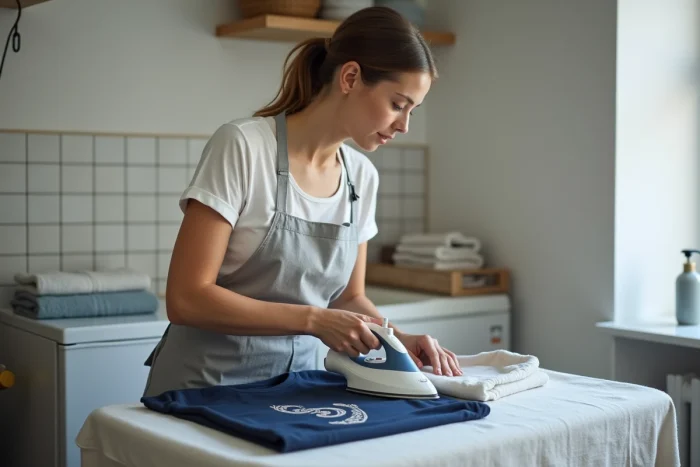
A household iron does not guarantee uniform pressure across the entire surface of the design. Central areas receive more heat than the edges, which explains why peeling almost always starts at the edges of the flocking. A heat press ensures an even distribution of temperature and pressure, but not everyone has one.
If you use an iron, press firmly without sliding the iron. The classic back-and-forth motion of ironing moves the vinyl before the adhesive sets. Steam must be turned off: moisture interferes with the melting of the hot-melt glue.
Tumble dryers and steam programs: an underestimated peeling factor
Recent tumble dryer programs (humidity sensors, steam cycles, anti-wrinkle) subject the flocking to repeated thermal and mechanical stresses that older cycles did not produce. The combination of humid heat and mechanical tumbling weakens the bond between the adhesive and the fiber, especially if the initial application was not optimal.
Air drying remains the safest method to preserve a heat-activated marking. If the tumble dryer is the only option, a low-temperature program without steam limits damage. Turning the garment inside out (design on the inside) also reduces direct friction on the flocking.
Reattaching a peeled flocking: technique and limits
When the design starts to lift, repair is possible as long as action is taken early. A flocking whose adhesive has completely dried or whose surface has been altered by repeated washes will not adhere properly again.
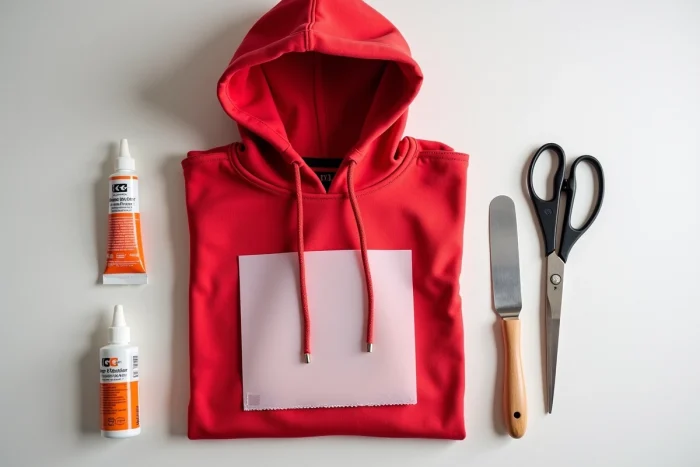
What to gather before starting
- An iron set to the appropriate temperature for the fabric (cotton, polyester, blend), steam turned off
- A sheet of parchment or Teflon paper to protect the design from direct contact with the soleplate of the iron
- A hard, flat surface under the fabric (a soft ironing board is not sufficient; a wooden board is better)
What happens under the protection sheet
The heat reactivates the residual hot-melt glue. By pressing firmly for about fifteen seconds without moving, the adhesive melts and re-establishes contact with the fibers. Pressure is as important as temperature: without firm pressure, the glue melts but does not penetrate the fabric.
After passing the iron, let the garment cool flat. Handling the fabric while it is still warm risks breaking the bond before the adhesive solidifies.
When reactivation is not enough
If the flocking peels off again after this operation, the original adhesive is likely exhausted. Two options remain feasible:
- Apply a specific textile glue (like wash-resistant fabric glue) in a thin layer under the peeled areas, then press with heat
- Completely remove the flocking and apply a new design in flex or sublimation, depending on the nature of the fabric
- For sports jerseys or cherished items, entrust the reapplication to a professional equipped with a calibrated press
Field reports vary on the durability of a reattachment with textile glue: some markings hold up for dozens of washes, while others fail after the third cycle. The quality of the glue used and the cleanliness of the reattached area (absence of residues from old adhesive) play a decisive role in the outcome.
A well-applied flocking from the start, on a fabric free of problematic surface treatments, with suitable adhesive and sufficient pressure, should not peel off. When it does, the diagnosis involves identifying the weak link in this chain, rather than merely attempting a blind reattachment.