
Honey is still perceived as a “natural” sugar, thus better for health. This idea leads many people, including diabetics, to substitute white sugar with it in their daily diet. The metabolic reality of honey is more complex than its image suggests, and recent official recommendations have clarified several points.
Honey and free sugars: what recent official recommendations say
The 2024 update of the Standards of Care in Diabetes from the American Diabetes Association classifies honey in the same category as table sugar. All free sugars, including honey, must be limited in the nutritional management of diabetes. No specific benefit is attributed to honey compared to white sugar.
The 2022 WHO report on free sugars supports this view. Honey is listed alongside agave syrup and maple syrup, with no “health” exceptions. This framing changes the game for those considering honey and sugar-free diets for diabetics as a viable option without restrictions.
Specifically, replacing two tablespoons of sugar with two tablespoons of honey in yogurt does not change the free sugar load of the meal. The body receives fructose and glucose in both cases. The difference lies in a few micronutrients present in honey, but in quantities too small to offset the effect on blood sugar.

Glycemic index of honey: a variability that traps diabetics
Have you noticed that acacia honey is often recommended for diabetics? This recommendation is based on its reputedly lower glycemic index, linked to its higher fructose content compared to glucose. The problem is that the glycemic index varies greatly from one honey to another, even within the same floral designation.
A review published in 2023 in the journal Nutrients shows that commercial honeys have glycemic indexes ranging from low to high depending on their actual composition. The fructose and glucose content, as well as the possible presence of added syrups, profoundly alter the glycemic behavior of the product.
The issue of adulterated honeys
A 2022 study in Food Chemistry highlighted a concrete risk. Honeys mixed with industrial syrups behave like table sugar in terms of blood sugar. A diabetic who buys “pure” honey without traceability guarantees may consume a product whose metabolic effect is identical to that of the sugar they are trying to avoid.
The majority of low-cost imported honeys are likely to be adulterated. For a diabetic, choosing honey with verifiable origin and production methods is not a luxury; it is a metabolic precaution.
Incorporating honey into a sugar-free diet: strict conditions
Completely giving up honey is not the only option, but incorporating it requires a precise framework. For diabetics whose condition is well-managed, several conditions must be met:
- Limit to one to two teaspoons per day, never more, and only during a meal containing fiber or protein that slows sugar absorption
- Prefer acacia honey with traceable origin, as its higher fructose content generally gives it a lower glycemic index than wildflower honeys
- Count honey in the total carbohydrate intake of the meal, just like bread, fruits, or any other starch
- Never consume honey on an empty stomach or outside of meals, as the effect on blood sugar is then amplified without food restraint
This framework excludes poorly managed diabetes. If the HbA1c level exceeds the targets set by the doctor, honey has no place, even in small amounts.
Raw honey or pasteurized honey: a distinction that matters
Raw honey retains its enzymes, antioxidants, and original composition. Pasteurized honey, heated to remain liquid longer, loses some of these compounds. For a diabetic, raw honey offers a more interesting nutritional profile, even if the difference on blood sugar remains modest.
The real issue lies in the quality of the product. Raw, monofloral honey purchased from a verified beekeeper offers guarantees that a low-end honey from a supermarket does not. The higher price curbs overconsumption, which paradoxically is an advantage for someone who needs to limit their sugar intake.
Blood sugar and honey: monitor rather than guess
Each body reacts differently to honey. Two type 2 diabetics consuming the same amount of the same honey may observe very different blood sugar spikes. This individual variability makes general recommendations insufficient.
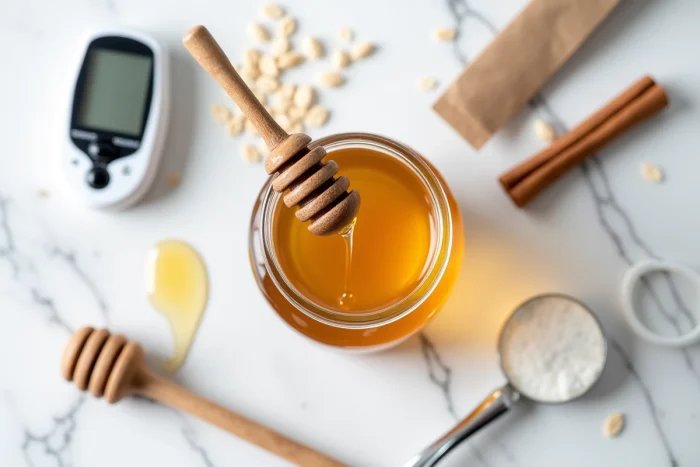
The only reliable method is to measure blood sugar before and after consuming honey, over several days, to observe personal response. Regular blood sugar monitoring allows for adjusting the amount without taking risks. A diabetic who notices a spike higher than what their medical protocol tolerates knows they need to reduce the dose or give it up.
Honey is neither a forbidden food nor a free food for diabetics. It is a sugar whose place in the diet depends on the type of diabetes, overall glycemic balance, and the quality of the chosen product. Replacing sugar with honey without changing the amount consumed does not constitute a nutritional improvement. Reducing the total intake of free sugars remains the priority, whether the source is honey, maple syrup, or powdered sugar.