
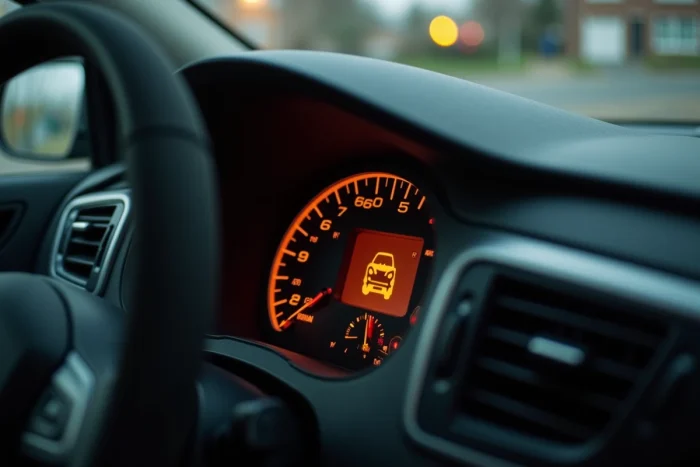
On a Volkswagen Polo 5, the orange engine light takes the form of a small stylized engine icon on the dashboard. Its illumination indicates a discrepancy detected by the computer between the values recorded by the sensors and the expected operating parameters. This warning can signal both a minor issue and a serious mechanical failure, and the course of action largely depends on the context of its appearance.
OBD Reading and Technical Inspection: An Orange Light That Carries More Weight Than Before
Since the end of 2023, French technical inspection centers have been more rigorously utilizing mandatory OBD reading on pollution control systems. For Polo 5 owners, the consequence is direct: an active fault code in the computer (type P0xxx) can now lead to a re-inspection, even if the vehicle is running without any apparent symptoms.
Polo 5 diesel models equipped with a particulate filter are the most exposed. An orange engine light related to a fault in the emissions control system, long tolerated by drivers, becomes a reason for refusal during the technical inspection. This development, detailed by UTAC-OTC in its technical bulletins, changes the game for owners who had been postponing diagnostics.
To understand the meaning of the orange engine light on Volkswagen Polo 5, it is essential to distinguish between two situations: a light that appears intermittently and goes out, and a steady light that remains on continuously, indicating that a fault code is permanently stored.
Polo 5 Gasoline: Ignition Misfires, Coils, and E10 Fuel
The gasoline engines of the Polo 5 (1.2, 1.2 TSI, 1.4 TSI) share a common point: a marked sensitivity to ignition misfires. The testimony of a Polo 5 1.2L 60hp owner on a specialized forum illustrates the classic path: engine light on the highway, loss of power, vehicle stopping, and months of searching before a VW dealer identified a combustion misfire in a specific cylinder.
In this documented case, replacing the spark plugs, ignition coils (with manufacturer parts), and updating the engine computer resolved the issue. The same light came back on later, this time with a vehicle that was “stuttering” to the point of being unable to travel a few hundred meters.
The Role of SP95-E10 on Low-Mileage Polo 5s
Since 2022, several multi-brand garages and VW networks have reported an increase in orange engine lights related to the use of SP95-E10 on low-mileage gasoline Polo 5s. The phenomenon manifests as clogging of the injection system and cold ignition misfires, with fault codes pointing to an air-fuel mixture problem.
Field feedback varies on this point: some technicians clearly attribute these symptoms to ethanol, while others believe that the clogging mainly comes from the lack of engine use (short trips, low RPMs). In both cases, the recommendation often comes down to:
- Cleaning the injection system, sometimes by simply adding a detergent additive to the tank
- Driving regularly at sufficient RPMs to reach optimal operating temperature
- Switching to SP98 for a few tanks if misfires persist, to assess the impact of the fuel
Timing Chain and Manufacturer Campaigns on the Polo 5
One aspect rarely addressed in general guides concerns the technical campaigns launched by Volkswagen on certain Polo 5s. The engines from the EA111 family, particularly the 1.2 TSI, have been the subject of recurring reports related to failing timing chain tensioners. These defects can trigger an orange engine light even before serious mechanical symptoms appear.
The KBA recall database in Germany lists several reports on this subject between 2022 and 2023. In practice, some VW dealers accept partial coverage for the replacement, even outside of warranty, provided that the maintenance booklet is complete and that the revisions have been performed within the network.

Check for a Recall or Technical Campaign
Before paying for a complete diagnosis, it is worth contacting a VW dealer with the vehicle’s chassis number. The internal system allows checking if the Polo 5 is affected by a TSB (Technical Service Bulletin) or an unperformed recall. A manufacturer campaign may cover all or part of the repair, which radically changes the budget to be planned.
Flashing or Steady Engine Light on Polo 5: Two Different Urgencies
The distinction between a steady engine light and a flashing engine light is not cosmetic. A flashing light indicates an active and repeated ignition misfire, which can damage the catalyst. In this situation, immediately reduce speed and head to a garage without forcing the engine is the only appropriate reaction.
A steady light, on the other hand, indicates a stored fault but not necessarily critical at the moment. The vehicle can generally be driven at a moderate pace to a workshop, provided that no other symptoms arise (smoke, abnormal noise, sudden loss of power).
Elements to monitor alongside the engine light:
- The coolant temperature warning light, which, when illuminated simultaneously, indicates overheating
- The oil pressure light, which requires immediate stopping
- The behavior of the engine speed at idle, which may reveal an injection or ignition problem
- The fuel consumption, often increasing when the computer goes into degraded mode
OBD diagnostics remain the only reliable way to identify the exact cause. Consumer OBD devices can read fault codes, but their interpretation requires cross-referencing the code with the context of its appearance. A P0300 code (random misfires) on a Polo 5 1.2 TSI does not point to the same repair as on a 1.6 TDI.
The orange engine light on a Polo 5 is not trivial since the strengthening of OBD reading during technical inspections. Whether it is an ignition misfire, fuel-related clogging, or a timing chain defect covered by a manufacturer campaign, quick diagnosis remains the most economical response. Delaying intervention exposes one to a heavier bill and, now, to a re-inspection.