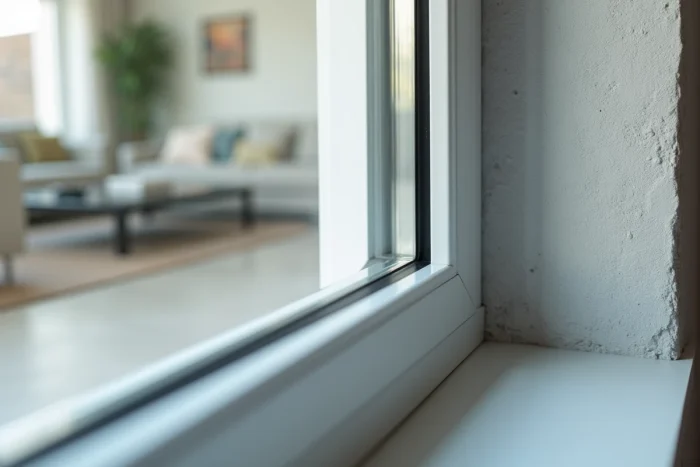
The fixed glass refers to a non-opening glazing that is sealed directly into the window frame. Contrary to what the term might suggest, it is not a specific type of glass, but rather a method of installation. The fixed part, or “dormant,” is the stationary part of the frame, anchored to the wall. When the glazing is integrated without an opening, it is referred to as fixed glass.
This configuration can be found in various contexts: transoms above an entrance door, large glass facades, interior skylights, or stairwell windows. The common point is always the absence of an opening mechanism.
Fixed glass ratio: an underestimated technical parameter
The ratio between the area occupied by the frame (dormant) and that occupied by the glazing directly affects the performance of a joinery. The thinner the dormant is compared to the glazed area, the higher the useful solar gains and the greater the indoor brightness.
The RE2020, applicable to new residential buildings in France since 2022, has increased attention to this ratio. The calculations for Bbio (bioclimatic needs) take into account passive solar gains. Application reports show that maximizing the glazed area while limiting thermal bridges at the frame is one of the keys to achieving the required performance levels.
A fixed glass, by definition, eliminates hardware and opening seals. The frame is reduced to the strict minimum. This is why architects frequently use it on facades where opening is not necessary: the gain in glazed area is immediate, without compromising on airtightness.
To delve deeper into the definition of fixed glass on Immobilier et Particuliers, the topic is discussed from the perspective of residential housing and common renovations.
Fixed dormant and thermal insulation: how the absence of an opening changes things
The opening of a window (the movable part) is the weak link in insulation. It is at the junction between the opening and the dormant that linear thermal bridges and air leakage defects concentrate. Removing this junction significantly alters the thermal behavior of the joinery.
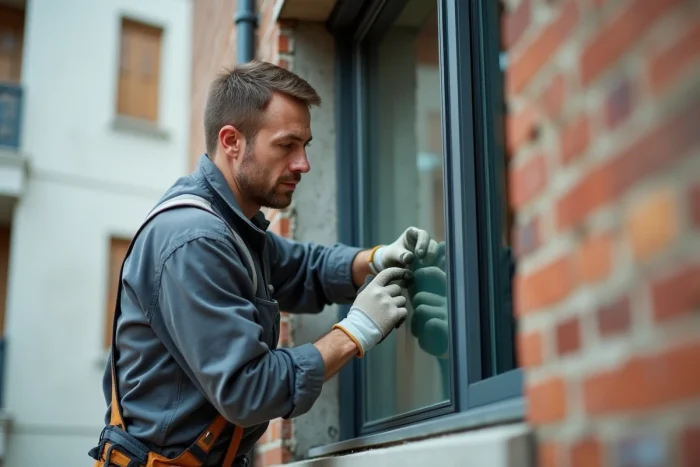
A fixed frame reduces thermal bridges to the sole contact between the dormant and the wall. This point still needs to be treated carefully (expanding foam, compression tape, sealing membrane), but there is no longer a thermal bridge related to the closure itself.
On the acoustic side, the logic is the same. The absence of a mobile compression seal eliminates a common source of sound transmission. For facades exposed to noise (proximity to a road, railway), combining fixed glass with acoustic laminated glazing offers a level of sound attenuation that is difficult to achieve with a standard opening.
Limitations to be aware of
The absence of an opening eliminates any possibility of natural ventilation through the window. In inhabited rooms (bedrooms, living rooms), fixed glass cannot be the only joinery: regulations require ventilation, ensured either by other openings or by a mechanical ventilation system.
Cleaning the exterior face also poses a practical problem, especially on upper floors. Without access from the outside (balcony, lift), maintenance becomes complicated. This point is rarely mentioned at the time of choice, but it determines long-term satisfaction.
PVC and aluminum profiles: recent developments in fixed frames
Since 2022-2023, several manufacturers of industrial joinery have developed profiles specifically designed to accommodate heavy glazing in fixed configuration. Deceuninck (Elegant range, France catalog 2023) and Profine/Kömmerling (76 and 88 mm systems, technical documentation 2023) offer frames with integrated reinforcements to limit deformations under the load of triple glazing or thick laminates.
These profiles meet a concrete need: a heavy triple glazing can weigh two to three times more than standard double glazing. Without appropriate reinforcement in the dormant, the frame deforms over time, compromising airtightness and the integrity of the glazing seal.
- Reinforced PVC profiles integrate steel or composite reinforcements sized for the loads of fixed triple glazing, which was not systematic before 2022.
- Aluminum frames with thermal break allow for thinner sections with equal mechanical resistance, favoring the glazing/frame ratio.
- Some mixed systems (wood-aluminum) combine the rigidity of wood in the internal structure with the thinness of aluminum on the exterior side, but at a significantly higher cost.
These technical developments remain little visible in general guides. Field feedback varies on the choice between PVC and aluminum for a fixed frame: PVC offers a better insulation coefficient for the frame, while aluminum allows for thinner sections and therefore a larger glazed area. The project’s context (exposure, size of the opening, budget) usually settles the debate.
Selection criteria for fixed glass in renovation
In renovation, replacing an opening glazing with fixed glass is justified in specific cases. Before validating this choice, a few points deserve verification.
- Does the room have another source of ventilation (another opening window, mechanical ventilation)? Fixed glass never replaces an opening joinery in a main room without an alternative ventilation.
- Is external access for cleaning feasible? On the ground floor or with a balcony, this question does not arise. On upper floors without access, maintenance costs must be anticipated.
- Can the existing frame support heavier glazing (triple glazing, laminated)? If the frame is old or undersized, complete removal and replacement of the dormant will be necessary, which alters the budget.
- The installation in a tunnel, applied, or rebate determines the maximum thickness of the integrable glazing. A prior diagnosis of the existing opening avoids unpleasant surprises.
The case of transoms and fixed sills
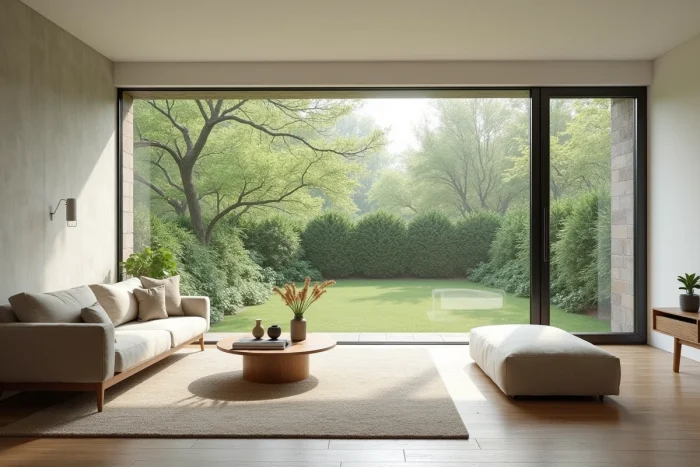
Transoms (glazed part above a door or window) and fixed sills (lower part under a window) are the most common locations for fixed glass in renovation. These areas do not need an opening and benefit from being glazed for brightness. The dormant here is often of small section, maximizing the contribution of natural light.
The selection of the type of glazing (double, triple, laminated, solar control) depends on the orientation of the facade and the thermal or acoustic insulation constraints of the building. Solar control glazing is justified on south or west facades to limit summer overheating, while acoustic laminated glazing will be prioritized in noisy environments.
Fixed glass remains a discreet yet structural component of a building’s envelope. Its choice impacts thermal performance, brightness, and acoustic comfort in the long term. The only preliminary question that really matters: does this window need to open?